If you haven’t thought much about artificial intelligence and cybersecurity, that’s understandable. AI can feel like a big-picture, enterprise-level concern. But the data tells a different story — one that affects businesses of every size, including yours.
The threat landscape has changed significantly over the past two years. What used to require a skilled hacker and hours of effort can now be automated, personalized, and deployed at massive scale in minutes. Here’s what that means for your business, and what you can do about it.
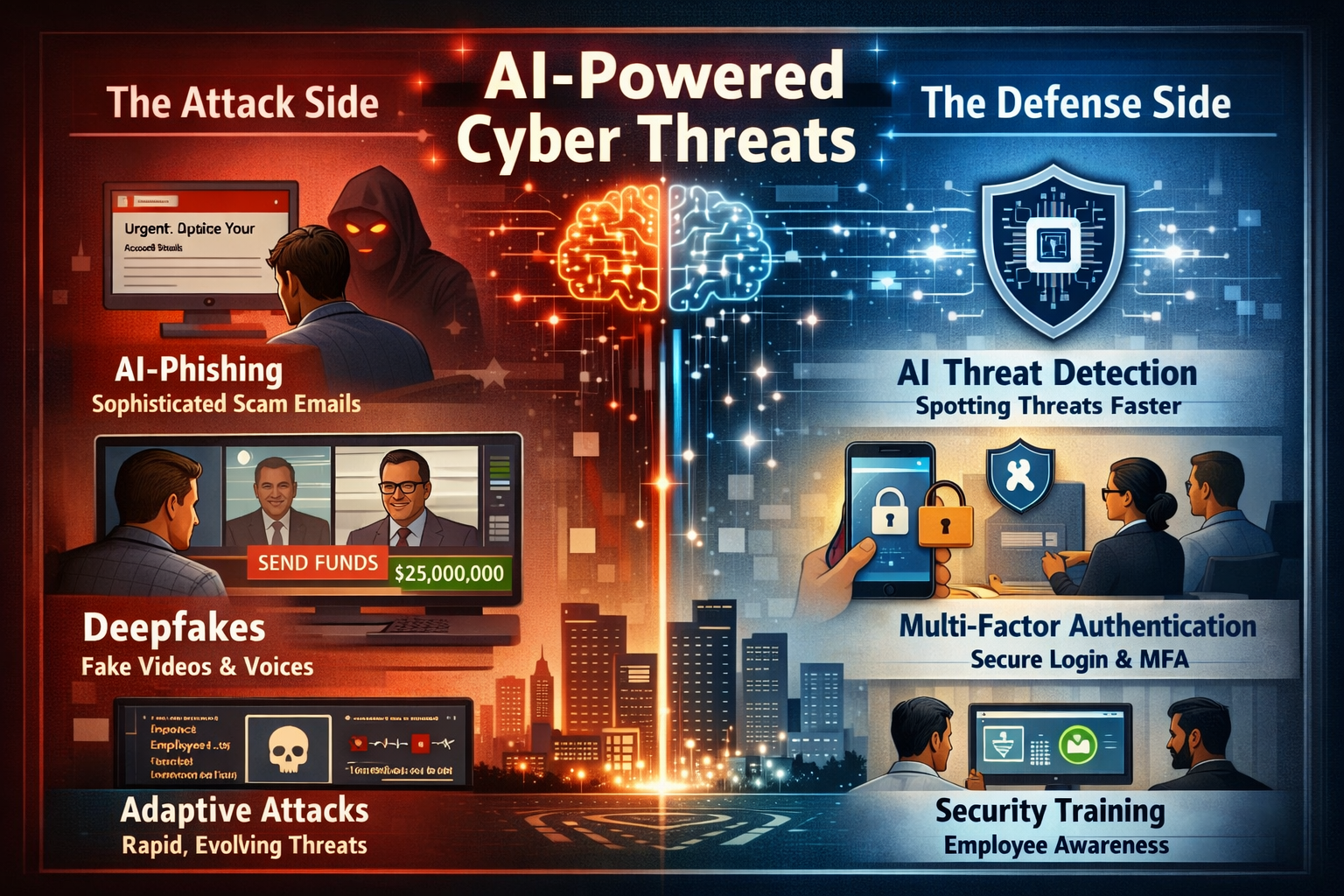
The Attack Side: How Criminals Are Using AI
Phishing That Actually Works
Traditional phishing emails were easy to spot — awkward grammar, generic greetings, suspicious links. AI has changed that completely.
Nearly 83% of phishing emails are now AI-generated Kelser Corp, and they’re far more convincing than what your employees were trained to look for. IBM security researchers found that AI needed only 5 prompts and 5 minutes to build a phishing campaign as effective as one that took human experts 16 hours to create. Strongestlayer
The result: AI-generated phishing achieves a 54% click-through rate, compared to just 12% for traditional phishing campaigns. The Network Installers That’s not a marginal improvement — that’s a fundamental shift in how dangerous these attacks are.
Deepfakes: When You Can’t Trust What You See or Hear
The more alarming development is deepfake technology — AI-generated audio and video that can convincingly replicate real people.
In early 2024, a finance employee at a multinational firm transferred $25 million to fraudsters after attending what appeared to be a legitimate video conference with the company’s CFO and senior leadership. Every face on screen, every voice — all AI-generated deepfakes created from publicly available footage. Brside
This isn’t an isolated incident. More than a quarter of SMBs report having experienced a deepfake scheme. VikingCloud And deepfake fraud incidents have increased by over 2,100% in the last three years. Keepnet Labs
For small and mid-sized businesses, the risk is especially real. 62% of small businesses faced AI-driven attacks in 2025, with deepfake audio and video scams rising sharply. All About AI Attackers used to focus on large enterprises because that’s where the money was. AI has made targeting smaller organizations just as worthwhile — at almost no additional cost.
Attacks That Adapt in Real Time
One of the most unsettling capabilities AI gives attackers is the ability to learn and iterate quickly. When a particular email variant triggers spam filters, AI systems automatically adjust — where human attackers might take days to pivot after detection, AI systems adjust in hours or minutes. Brside
This means traditional, static defenses — basic spam filters, outdated firewall rules — are no longer sufficient on their own.
The Defense Side: How AI Can Work For You
The same technology powering attacks is also powering the most effective defenses available today. And this is where businesses that act now have a real advantage.
Faster Threat Detection
Organizations using AI-driven security systems detect threats 60% faster and discover breaches an average of 108 days sooner than those without AI-based defenses. The Network Installers In cybersecurity, time is everything. The faster a threat is identified, the lower the cost and damage.
Reduced Breach Costs
Organizations using AI-driven security platforms reduce breach costs by an average of $1.9 million All About AI compared to those relying on traditional tools alone. For an SMB, that number could be the difference between recovering from an incident and closing your doors.
Smarter Email and Endpoint Protection
Modern AI-powered security tools analyze behavior, context, and intent — not just known signatures. That means they catch novel attacks that traditional tools miss, including the personalized, AI-crafted phishing emails that now make up the majority of threats.
What SMBs Should Do Right Now
You don’t need to overhaul everything overnight, but there are concrete steps that make a significant difference:
- Update your security awareness training. The phishing examples your team practiced spotting two years ago look nothing like today’s attacks. Training needs to reflect current threats, including voice scams and video impersonation.
- Enable multi-factor authentication (MFA) everywhere. AI can crack 85.6% of common passwords in under 10 seconds The Network Installers, making password-only authentication a critical vulnerability. MFA is a non-negotiable baseline.
- Implement email security that goes beyond spam filtering. Look for tools that use behavioral analysis and AI-based threat detection, not just blocklists.
- Establish a verification protocol for financial requests. Any wire transfer, payment change, or access request — regardless of how it arrives — should require a secondary, out-of-band confirmation. The $25 million deepfake incident could have been stopped with a simple callback policy.
- Know your current risk posture. Many SMBs are operating with outdated security configurations and don’t know it. A security assessment gives you a clear picture of where you’re exposed before an attacker finds out first.
The Bottom Line
AI hasn’t made cybercriminals smarter — it’s made them faster, cheaper, and more scalable. The attacks targeting Denver businesses today are more convincing and more persistent than anything we’ve seen before.
The good news is that the same technology is available on the defense side, and working with an experienced IT partner means you don’t have to figure it out alone.
Not sure where your business stands? SAF offers security assessments for Denver-area businesses that give you a clear, honest picture of your current risk — and a practical plan to address it. Contact us today to get started.